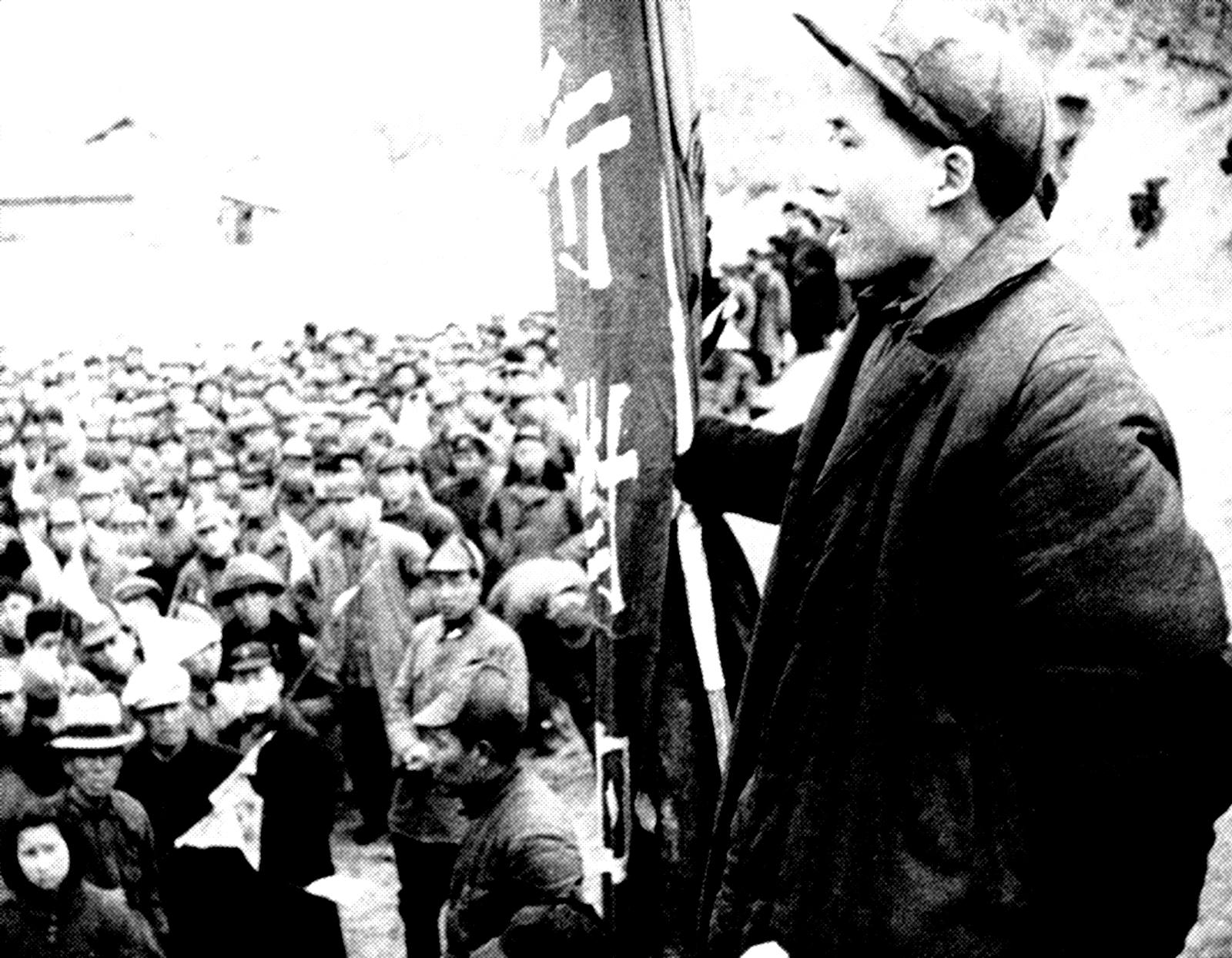
DECLARATION OF THE LONG MARCH EDITORIAL BOARD
The red army fears not the trials of the march,
holding light ten-thousand crags and torrents.
The Five Ridges wind like gentle ripples
and the majestic Wumeng roll by, globules of clay.
Warm, the steep cliffs lapped by the waters of golden sand,
cold, the iron chains spanning the Tatu river.
Minshan’s thousand li of snow joyously crossed,
the three armies march on, each face glowing.
– Mao Zedong, ‘The Long March,’ October, 1935.
In ON MARXISM-LENINISM-MAOISM, our Editorial Committee outlines its conception of of the principal task of communists in the present conjuncture:
“the rectification of the general line of the anti-revisionist communist trend[through]the uncompromising rejection of the revisionist and dogmatic residues that have long deformed the dominant conception of Marxism in the United States, as well as the establishment of a firm ideological foundation for the reconstruction of a genuine communist party.Such a foundation presupposes the mastery of Maoist ideology in its full scope as the unity of dialectical and historical materialism—a scientific instrument enabling the working class not only to interpret the world but to transform it.”
Our period, marked by the absence of a real vanguard formation of the working class movement, is one of dispersal and disorganization, wherein the anti-revisionist forces (such as they exist) are grouped into small circles with varying levels of politico-ideological and organizational development. Many of these organizations take up a sober assessment of this dispersal and understand, correctly, the need for an attitude of communist humility, recognizing that no currently existing formation has any legitimate claim to national leadership, and that the task before us is to produce that leadership through genuine struggle for unity. Others take up an attitude of bloviating hostility, conceiving of their group as sole bearers of the truth merely because they manage to shout it the loudest and expecting others to fall in line, proclaiming—as once did our old friends in Texas—that their task must be to “convert them into comrades, or convert them into dust.” Still others take a fully monastic form, as small local (or online) groups studying together at a distance from both the real movement and the rest of the Maoist trend, amateur and squabbling though it may be.
This atmosphere of dispersal and disunity is hardly historically unique. Lenin famously described a strikingly similar situation in Russia at the turn of the 20th century, and we quote him at length:
“The principal feature of our movement, which has become particularly marked in recent times, is its state of disunity and its amateur character, if one may so express it. Local study circles spring up and function independently of one another and—what is particularly important—of circles that have functioned and still function in the same districts. Traditions are not established and continuity is not maintained; local publications fully reflect this disunity and the lack of contact with what Russian social-democracy has already achieved.
Such a state of disunity is not in keeping with the demands posed by the movement in its present strength and breadth, and creates, in our opinion, a critical moment in its development.The need for consolidation and for a definite form and organisation is felt with irresistible force in the movement itself; yet among social-democrats active in the practical field this need for a transition to a higher form of the movement is not everywhere realised.On the contrary, among wide circles an ideological wavering is to be seen, an infatuation with the fashionable “criticism of Marxism” and with “Bernsteinism,” the spread of the views of the so-called “economist” trend, and what is inseparably connected with it—an effort to keep the movement at its lower level, to push into the background the task of forming a revolutionary party that heads the struggle of the entire people.
It is a fact that such an ideological wavering is to be observed among Russian social-democrats; that narrow practicalism, detached from the theoretical clarification of the movement as a whole, threatens to divert the movement to a false path.No one who has direct knowledge of the state of affairs in the majority of our organisations has any doubt whatever on that score[…] We do not desire to exaggerate the gravity of the situation, but it would be immeasurably more harmful to close our eyes to it.”1
This passage—from the declaration of the theoretical journal Iskra—is followed by the following pronouncement: “before we can unite, and in order that we may unite, we must first of all draw firm and definite lines of demarcation. Otherwise, our unity will be purely fictitious, it will conceal the prevailing confusion and binder its radical elimination.”2Lenin’s diagnosis of a pervasive and deep ideological disorganization in the Russian social-democratic movement should resonate deeply with anyone experienced in the political and ideological discourses of our contemporary communist tendency, as should his prescription: an open and thoroughgoing discussion on the burning questions of our movement.
It is probably unsurprising—if, perhaps, a little presumptuous—that we harken back to the declaration of Iskra in the declaration of our own editorial board in light of our assessment of the current situation.
It is our position that, given our perception of the state of the Maoist trend, the condensation of an anti-revisionist political tendency on a national scale (e.g., the formation of a real national center or pre-party apparatus) requires the unity of a broad layer of communists around a general political line, which, as Lenin put in his own context, can “eliminate the discordance and confusion that—let us be frank!—reign among social-democrats at the present time.” This line must, on the basis of the Marxist-Leninist-Maoist ideological outlook, articulate the overall political reality of the U.S. social formation—including the contradictions of national oppression, patriarchy, and the nature of the international situation—and provide guidance to the communist movement in the mobilization of proletarian class forces in the struggle for political power.
Much as the disunity of the communist trend should be obvious for all who care to look, such a leading general line obviously does not currently exist. Nevertheless, we describe the principal task of communists as the rectification of the general political line because, despite the formal absence of a substantively articulated general line, the relatively low theoretical and politico-ideological level common to the Maoist milieu means that an informal general line dominates, vacillating between left-opportunist dogmatism and right-opportunist pragmatism. We, again, take for granted that this vacillation is plain to see to anyone taking the time to look seriously at the amateurism on display in the present-day circles.
Against such deviations, all communists are tasked with the protracted work of mastering our ideology and applying it to the U.S. context, “holding light ten-thousand crags and torrents” along the road to the reconstruction of a genuine Maoist communist party that can lead the working class in the struggle for political power through the initiation of people’s war.
This task entails the defense of dialectical and historical materialism against its distorters. The legacy of the revisionist degeneration of the communist movement (as well as the influence of the ambient American pragmatist attitude) has had a profound negative impact on the basic ideological orientation of the emerging Maoist tendency, manifesting in a consistent under-estimation of the value of theoretical work and an anti-intellectual orientation. This means that in order to take up the struggle to combat revisionism (and the hegemony of non-Marxist ideas in the mass movement), we must first overcome the all-around weakness of theoretical and ideological development across the communist movement as a whole.
Correcting this ideological primitiveness does not only mean a program of patient study of the classics, although this is absolutely necessary for the training of communist forces organized by the circles. Concretely, in order to overcome the immediate ideological crisis, our understanding of the dialectical method and historical materialist principles must develop through its clarification in the context of the struggle for a leading line for the communist movement. That is, the process of constructing a firm ideological basis for the movement must necessarily pass through the various struggles over specific questions of line as they emerge over the course of the living class struggle, taking up philosophical questions not merely as ends in themselves but for their significance in responding to the reality of the U.S. social formation.
The impact of our theoretical weakness means that our trend has little meaningful experience with engaging in this kind of theoretical debate, and no clear sense of its stakes beyond shortsighted questions of practical work. Consequently, where struggle over theoretical and ideological questions occurs, it is blunted by antagonistic bloviation and disregard for questions of dialectical materialist method; precise argumentation is abandoned in favor of “scoring points,” posturing, or bombastic rhetoric. Substantive philosophical questions, when they are taken up at all, are dismissed as “abstract” and useless to the “real work” of practice. While we appreciate that the retreat of Marxist philosophy into the bourgeois academy (or into fashionable semi-academic publishing houses) has certainly resulted in the mass production of sterile petit-bourgeois philosophical tracts masquerading as Marxism, surrendering the terrain of philosophy to our enemies wholesale has meant that the philosophical equipment to which we have access today largely takes the form of “popularizer documents” that themselves engage in mechanistic distortions or stilted presentations of our ideology, resulting in a cycle of underdevelopment from which we are now responsible for breaking.
Consequently, today, as in Lenin’s day, we perceive the need for open polemic conducted in full view of our embryonic political trend (and the growing layers of class-conscious workers and advanced masses sympathetic to it) around questions of ideology and Marxist theory which can “clarify the depth of existing differences” between the various circles and local groups, and which can serve in the correction of our current theoretical primitiveness by developing a “common literature, consistent in principle and capable of ideologically uniting revolutionary social-democracy, since we regard this as the pressing demand of the movement today and a necessary preliminary measure towards the resumption of party activity.”3 We conceive of the function of LONG MARCH accordingly: as a space for serious theoretical production and comradely struggle, open not just to the viewpoint of our own circle and its sympathizers, but also those with whom we disagree (so long as they are motivated by a genuine pursuit of unity of anti-revisionist communists!). We therefore welcome and encourage the submission of documents—polemics, criticisms, theoretical interventions, summations, etc.—although we reserve the right to publish such documents with our own criticisms or responses where they diverge from our own orientation, as laid out in ‘On Marxism-Leninism-Maoism.’
As we argue above, the principal task today is to rectify the general political line of the communist trend, which requires that we analyze the political reality of the United States and its component contradictions in order to guide our interventions in the working class movement and lead the revolutionary struggle for power according to the scientific outlook of Marxism-Leninism-Maoism. Rectification does not involve simply drafting a document which describes those phenomena empirically or on an a-priori basis. Even if a substantive text attending to those questions could be drafted by any individual circle active in the trend today (which we doubt), it would not accomplish the real task of rectification, which is to unite the advanced around that leading line. This is why we describe the struggle for rectification of the general line as a “Long March”: it is an immense undertaking to lay the foundations for the construction of a party capable of mobilizing the masses in their millions for the armed struggle for power. Those distorters of Marxism who claim that such a task can be undertaken using ready-made slogans imported from a moribund international movement or through myopic retreat into permanent study at a distance from the class movement continue to hoist the banner of a long tradition of nearsighted rejection of the difficult road ahead.
We, on the other hand, aim to take up difficulty proudly and openly, each face glowing. We hope you join us on the march.
1Lenin, ‘Declaration of the Editorial Board of Iskra.’ 1900.
2ibid.
3ibid.