Introduction
Marxism-Leninism-Maoism is the highest stage of the ideology of the revolutionary proletariat. To be an anti-revisionist communist today is necessarily to be a Maoist—to take up the universal lessons distilled from two centuries of revolutionary class struggle, from Paris and Leningrad to Shanghai and Ayacucho. As a science, Maoism is not a fixed doctrinal edifice but a theoretical horizon continuously enriched through its creative application to concrete social formations in the course of revolutionary practice, as well as through the broader historical development of human knowledge.
The LONG MARCH editorial board understands the principal task of our period to be the rectification of the general line of the anti-revisionist communist trend. This requires the uncompromising rejection of the revisionist, dogmatic and eclectic residues that have long deformed the hegemonic conception of Marxism in the United States, as well as the establishment of a firm ideological foundation for the reconstruction of a genuine communist party. Such a foundation presupposes the mastery of Maoist ideology in its full scope as the unity of dialectical and historical materialism—a scientific instrument enabling the working class not only to interpret the world but to transform it.
We insist that Marxism is a living science, whose fundamental propositions have developed through the systematic theoretical abstraction of the new knowledge generated in the course of the international proletariat’s class struggles. It is not a catechism to be memorized nor a pantheon of “Great Men” to be venerated in isolation from the mass movements they helped lead. While we honor Marx, Lenin, Mao, and other major contributors for their exceptional clarity and revolutionary leadership, we refuse to treat their work as detached from the collective, world-transforming practice of the masses. As the CPI (Maoist) correctly articulated in its founding documents,
“It is precisely because Marxism is a living science, and not a lifeless dogma, has living connection with, and serves practice, that it undergoes continuous development… The Theory, Ideology or science of Marxism-Leninism-Maoism is the synthesis of the experiences of class struggle in all spheres and in all countries over the last 150 years. It is a comprehensive whole of philosophy, political economy and scientific socialism or class struggle of the proletariat”1
Nonetheless, the classical triad of “philosophy, political economy, and scientific socialism” to which the Indian comrades point—a triad first formulated by Lenin in “Three Sources and Three Component Parts of Marxism” and subsequently absorbed into the vocabulary of Marxism as ideology—has too often been misused as a rigid metric to adjudicate whether a given theoretical innovation constitutes a “world-historic” development of the science. To the extent that we employ this lexicon, we do so descriptively rather than prescriptively, as an aid in grasping theoretical problems and not as a formal rubric in a quasi-Kantian quest for systematic completeness. Such scholasticism is inimical to the living study of Marxism.
At its core, Marxism-Leninism-Maoism is the synthesis of the experiences of class struggle waged by the international proletariat from its emergence on the global stage until today; it is a partisan, revolutionary ideology aimed at the seizure of state power by the working class, the socialist organization of the productive forces of modern society, and the eventual horizon of communism. Marx and Engels described this horizon as the abolition of private property, stating
“Modern bourgeois private property is the final and most complete expression of the system of producing and appropriating products, that is based on class antagonisms, on the exploitation of the many by the few. In this sense, the theory of the Communists may be summed up in the single sentence: Abolition of private property…the groundwork of all personal freedom, activity and independence…
When, in the course of development, class distinctions have disappeared, and all production has been concentrated in the hands of a vast association of the whole nation, the public power will lose its political character. Political power, properly so called, is merely the organised power of one class for oppressing another. If the proletariat during its contest with the bourgeoisie is compelled, by the force of circumstances, to organise itself as a class, if, by means of a revolution, it makes itself the ruling class, and, as such, sweeps away by force the old conditions of production, then it will, along with these conditions, have swept away the conditions for the existence of class antagonisms and of classes generally, and will thereby have abolished its own supremacy as a class. In place of the old bourgeois society, with its classes and class antagonisms, we shall have an association, in which the free development of each is the condition for the free development of all.”2
The abolition of private property articulated here is not to be understood as a mere policy item for a hypothetical socialist administration, but as the demand for a total transformation of social relations—a revolution that culminates in the extinction of class society itself and the liberation of the global majority from millennia of exploitation. It is toward this communist horizon that our political project is oriented.
The struggle to advance along this revolutionary path is the historic task of the international working class, achievable only under the leadership of its conscious political vanguard. Among the vanguard’s enduring responsibilities, in a conception dating back to the time of Marx and the First International, is the theoretical analysis of each revolutionary breakthrough and defeat, alongside the unrelenting struggle against distortions of its scientific ideology. We treat this work of theoretical production and ideological struggle as indispensable for any organization that seeks to inherit the legacy of proletarian revolution. The present document is offered as a provisional articulation of our understanding of Marxism-Leninism-Maoism, and as a contribution to the struggle for a higher level of unity among communists.
Marxism
Marxism was born from the scientific breakthroughs made by comrades Marx and Engels in response to the era of the revolutionary upsurge of the 1848 Revolutions, the Paris Commune, and the thunderous awakening of proletarian political consciousness which shook the world. Through their study of, and participation in, these great class struggles of their time, and the ideological struggle in their efforts to organize the movement into the International Workingmen’s Association (the First International), Marx and Engels discovered for the first time in history the laws of motion of capitalist production and synthesized historical materialism as the science of the development and change of social formations. They further articulated dialectical materialism—still in a provisional form—as the class struggle of the proletariat on the theoretical and philosophical terrain. Finally, and significantly, they exposed the nature of the bourgeois class dictatorship, and asserted the necessity of a revolutionary dictatorship of the proletariat counterposed to it which could facilitate the defense of the revolution and vouchsafe the transition to communism.
Marx himself identified what he saw as his main contributions to the working class movement in his March 5th letter to J. Weydemeyer:
What I did that was new was to prove: (1) that the existence of classes is only bound up with particular historical phases in the development of production, (2) that the class struggle necessarily leads to the dictatorship of the proletariat, (3) that this dictatorship itself only constitutes the transition to the abolition of all classes and to a classless society.3
Here, he refers us to historical materialism, the analysis of societies and their development through a concrete analysis of the social relations that exist within them, and the study of the laws of motion corresponding to the contradictions within those relations. How the society produces goods to satisfy human needs, or the contradictions between the productive forces and the relations of production, is primary among these contradictions. In contrast to pre-scientific theories of history that articulate historical developments as dictated by God, or “Great Men,” or “Ideas,” Marx argued
“In the social production of their existence, men inevitably enter into definite relations, which are independent of their will, namely relations of production appropriate to a given stage in the development of their material forces of production. The totality of these relations of production constitutes the economic structure of society, the real foundation, on which arises a legal and political superstructure and to which correspond definite forms of social consciousness. The mode of production of material life conditions the general process of social, political and intellectual life…At a certain stage of development, the material productive forces of society come into conflict with the existing relations of production—or, and this merely expresses the same thing in legal terms—with the property relations within the framework of which they have operated hitherto. From forms of development of the productive forces these relations turn into their fetters. Then begins an era of social revolution”4
Marx demonstrates that human social formations are organized around the production of objects of human need or want—an organization structured according to the level of development of the productive forces (the technological, theoretical and practical capacity of a social formation to produce goods), and the corresponding relations of production (the relationship between those who controls the productive forces and the direct producers). The relation between those who produce and those who live off that production represents the primary contradiction in societies; in other words,
The history of all hitherto existing society is the history of class struggle. Freeman and slave, patrician and plebeian, lord and serf, guild-master and journeyman, in a word, oppressor and oppressed, stood in constant opposition to one another, carried on an uninterrupted, now hidden, now open fight, a fight that each time ended, either in a revolutionary reconstitution of society at large, or in the common ruin of the contending classes.5
Marx and Engels show that the relations of production are not simple reflections of technological development but the historically specific forms in which a mode of production reproduces its conditions of existence. These relations correspond to the organization of the labor process and to the level and configuration of the productive forces internal to a given social formation. From within this structured whole, classes—effects of these relations rather than pre-given subjects—enter into antagonistic struggle as bearers of the objective interests inscribed by their structural positions. Such struggle, far from being an external supplement to the economy, constitutes a determinant moment in the reproduction and transformation of the mode of production: it displaces, modifies, and eventually organizes the existing articulation of forces and relations.
When the relations of production become a fetter on the further development of the productive forces (when the structure can no longer reproduce itself without the explosive resolution of its internal contradictions) an organic crisis emerges, marking an “epoch of social revolution.” It is precisely such an epoch that was inaugurated in the nineteenth century: the Industrial Revolution, by revolutionizing the productive forces, produced a new class, the industrial proletariat, whose struggle determined the shape of the political and ideological conjuncture. In asserting the interests structurally assigned to it, this class became capable not only of contesting the conditions of its own exploitation but of opening the possibility for a qualitatively new mode of production, and thus the liberation of humanity from the social relations that constrain it.
As Marx observes,
“The bourgeois mode of production is the last antagonistic form of the social process of production – antagonistic not in the sense of individual antagonism but of an antagonism that emanates from the individuals’ social conditions of existence – but the productive forces developing within bourgeois society create also the material conditions for a solution of this antagonism. The prehistory of human society accordingly closes with this social formation.”6
Marx here describes the class struggle between the bourgeois and proletariat as the “last antagonistic form”—for the first time in human history, class struggle has produced particular dominant contradictions that are capable of ending class society entirely.
Marx further develops this account in Capital,which begins from the analysis of the simplest unity of the capitalist mode of production: the commodity-form. This object of analysis is not chosen for its empirical obviousness but because it condenses, in embryonic fashion, the ensemble of contradictions which structure the totality of bourgeois society. Marx’s analysis demonstrates that what bourgeois political economy naturalizes as a relation between things is in fact a historically specific social relation, one that presupposes and reproduces a determinate configuration of producers, relations of production, and juridico-ideological forms. Commodity exchange thus appears as a relation of equivalence, but its very form presupposes the separation of direct producers from the means of production and the mediation of their social interdependence through the market, an ideological mystification integral to the reproduction of capitalist relations:
“The change of value that occurs in the case of money intended to be converted into capital, cannot take place in the money itself, since in its function of means of purchase and of payment, it does no more than realise the price of the commodity it buys or pays for; and, as hard cash, it is value petrified, never varying. Just as little can it originate in the second act of circulation, the re-sale of the commodity, which does no more than transform the article from its bodily form back again into its money-form. The change must, therefore, take place in the commodity bought by the first act, M-C, but not in its value, for equivalents are exchanged, and the commodity is paid for at its full value. We are, therefore, forced to the conclusion that the change originates in the use-value, as such, of the commodity, i.e., in its consumption. In order to be able to extract value from the consumption of a commodity, our friend, Moneybags, must be so lucky as to find, within the sphere of circulation, in the market, a commodity, whose use-value possesses the peculiar property of being a source of value, whose actual consumption, therefore, is itself an embodiment of labour, and, consequently, a creation of value. The possessor of money does find on the market such a special commodity in capacity for labour or labour-power.”7
This exposition of the labor theory of value discloses the specific mechanism by which surplus value is produced and appropriated. Exploitation is an effect of the structural conditions of the capitalist labor process, where labor-power, uniquely capable of producing more value than it costs to reproduce, becomes the source of profit. The “freedom” and “equality” of commodity exchange thus function as ideological forms that mask a determinate class relation operative within production.
Through this analysis, Marx isolates the fundamental contradiction of the capitalist mode of production: the contradiction between the increasingly socialized character of production and the private form of appropriation. This contradiction manifests itself at multiple levels of the structure: in the organized, technical unity of production within the individual enterprise, contrasted with the anarchic, competitive disorder of production at the level of the social whole, expressed in class terms as the antagonism between the bourgeoisie and the proletariat.
Capitalist crises, in Marx’s analysis, are regular, necessary expressions of this structural contradiction. They are moments in which the overaccumulation and overproduction intrinsic to the mode of production rupture its capacity for smooth reproduction, thereby revealing the limits and instability of the capitalist form itself.
We note here, following Lenin, that the textual structure of Capital gestures towards a philosophical orientation which is otherwise unsystematized in Marx own writings. Lenin remarks that, “If Marx did not leave behind him a “Logic” (with a capital letter), he did leave the logic of Capital.”8 We refer to this logic as dialectical materialism: the philosophical matrix of Marxism.
While, as Lenin notes, the mature Marx did not systematize a “Logic” of dialectical materialism (which would fill a role analogous to that of Capital viz. historical materialism), he did engage in attempts, with Engels, to elaborate it in the form of a theoretical struggle against idealism. Marx’s early theoretical struggle unfolds on two fronts: against the speculative idealism of classical German philosophy, and against the “mechanical materialism” of Feuerbach, whose reduction of the real to a static, contemplatively apprehended object ultimately reproduces the very ideological separation of thought and practice from which Marx sought to break. In The German Ideology, Marx formulates the necessary, fundamental inversion of idealism:
“The phantoms formed in the human brain are also, necessarily, sublimates of their material life-process, which is empirically verifiable and bound to material premises. Morality, religion, metaphysics, all the rest of ideology and their corresponding forms of consciousness, thus no longer retain the semblance of independence. They have no history, no development; but men, developing their material production and their material intercourse, alter, along with this their real existence, their thinking and the products of their thinking. Life is not determined by consciousness, but consciousness by life.”
The materiality of the social process—rather than an autonomous realm of ideas—constitutes the determinant instance for thought. Marx’s materialism thereby rejects Feuerbach’s linear and contemplative model, which presupposes that the laws of motion of social reality can be grasped independently of the historically specific practices that produce and transform it. Instead, Marx theorizes contradiction and transformation as immanent to the real itself. The external world determines consciousness not as a one-way mechanical causality, but through the development of social practices relating conscious subjects to their environment, in which contradictions are produced and resolved, with consciousness of those changes following alongside.
Here Marx’s Theses on Feuerbach become decisive:
The question whether objective truth can be attributed to human thinking is not a question of theory but is a practical question. Man must prove the truth, i.e., the reality and power, the this-sidedness of his thinking, in practice. The dispute over the reality or non-reality of thinking which is isolated from practice is a purely scholastic question…The highest point reached by contemplative materialism, that is, materialism which does not comprehend sensuousness as practical activity, is the contemplation of single individuals and of civil society…Philosophers have hitherto only interpreted the world in various ways; the point is to change it.9
Knowledge is then understood as the product of a determinate practice, situated within a contradictory social formation itself mediating the relationship between a thinking subject and the material world. Practical activity becomes the condition of possibility for theoretical adequacy; only by intervening in the world can thought verify its own truth-effects. What emerges here is the outline of a dialectical materialism in which the dialectic is re-articulated as the logic of the real. Dialectics thus ceases to be the self-movement of Spirit and becomes the concept of the uneven, conflictual processes through which reality develops, changes, and is apprehended in theoretical knowledge.
Marx’s insistence on practice as the criterion of truth marks a decisive rupture with all hitherto existing philosophy. He demonstrated that knowledge is inseparable from the practical, transformative activity through which human beings intervene in and reproduce the world; to “know” is not to contemplate a static object but to engage a material process in which intelligibility emerges through rational apprehension of changes effectuated as a consequence of conscious intervention. As he famously wrote in the 1873 Afterword to Capital:
The mystification which dialectic suffers in Hegel’s hands, by no means prevents him from being the first to present its general form of working in a comprehensive and conscious manner. With him it is standing on its head. It must be turned right side up again, if you would discover the rational kernel within the mystical shell.
The dialectic becomes a concept corresponding to the real movement of history, freed from the speculative teleology of Hegelianism and grounded instead in the contradictory processes of material social existence. Yet Marx’s explicitly philosophical writings on this question during the mature period of his thought remain fragmentary and nowhere are they fully systematized. The immense scientific labor of Capital arrested the possibility of a comprehensive philosophical presentation on Marx’s part. It fell to Engels, in the final decades of his life, to sketch the first outlines of a Marxist philosophy by extending and codifying Marx’s scattered insights on dialectics.
Engels’ intervention, particularly in his polemic against Eugen Dühring, foregrounds contradiction and motion as fundamental determinations of existence. As he writes:
“[S]o long as we consider things as at rest and lifeless…we do not run up against any contradictions in them… But the position is quite different as soon as we consider things in their motion, their change… Then we immediately become involved in contradictions… the continuous origination and simultaneous solution of… contradiction is precisely what motion is.”10
Here Engels identifies contradiction as immanent to the real and not merely a logical category—an insight continuous with Marx’s break from both idealism and mechanical materialism. Nevertheless, Engels’s attempts to generalize the dialectic across nature and society occasionally reintroduced idealist residues into Marxist theory, particularly through the adoption of Hegelian motifs such as the “negation of the negation.” Although Engels sometimes articulated a more open-ended conception of contradiction, recalling Spinoza’s insight that “every negation is itself an affirmation,” his frequently cited illustration of the barley grain imposes a teleological schema onto material processes:
Let us take a grain of barley…if such a grain of barley meets with conditions which are normal for it, if it falls on suitable soil, then under the influence of heat and moisture it undergoes a specific change, it germinates; the grain as such ceases to exist, it is negated, and in its place appears the plant which has arisen from it, the negation of the grain. But what is the normal life-process of this plant? It grows, flowers, is fertilised and finally once more produces grains of barley, and as soon as these have ripened the stalk dies, is in its turn negated. As a result of this negation of the negation we have once again the original grain of barley, but not as a single unit, but ten-, twenty- or thirtyfold…each repetition of this process, each fresh negation of the negation, enhances this process of perfection
In this presentation, the dialectic is conceptualized less as the uneven movement of material contradictions than as the reassertion of an originary unity at a “higher” level—an essentially Hegelian problematic. Such a perspective risks converting dialectics into a formalism and thus feeds into tendencies within the communist movement (notably within the Second International) that interpreted social development as a quasi-natural, automatic progression. This teleological and mechanistic outlook, imagining the “absolute inevitability” of socialism through capitalism’s internal dynamics alone, independent of revolutionary practice, draws ideological sustenance from precisely this misrecognized philosophical inheritance.
Nevertheless, Engels’s work, as Lenin later emphasized, rendered an indispensable service: it organized the first systematic front against idealism and helped clear conceptual ground for later scientific advances, even if its formulations required subsequent rectification.
Beyond these initial philosophical interventions, Marx and Engels’s polemical struggle against liberalism, anarchism, reformism, and idealism disclosed what might be called the core of Marxism: its unrelentingly revolutionary, partisan outlook. Since the Communist Manifesto, they underscored the indispensability of the proletariat’s seizure of political power through armed struggle, refusing the siren song of bourgeois radicalism in all its varieties. Their conflicts with Proudhonian mutualism and with Lassallean reformism reveal this core with particular clarity. Against Lassalle’s invocation of the “Iron Law of Wages” and the programmatic illusions embedded in the Gotha Programme, Marx exposed the ideological slippage by which bourgeois juridical categories were smuggled into the theoretical discourse of workers’ emancipation. As he sharply observes:
This equal right is an unequal right for unequal labor…It is, therefore, a right of inequality, in its content, like every right. Right, by its very nature, can consist only in the application of an equal standard; but unequal individuals (and they would not be different individuals if they were not unequal) are measurable only by an equal standard insofar as they are brought under an equal point of view, are taken from one definite side only – for instance, in the present case, are regarded only as workers and nothing more is seen in them, everything else being ignored.11
Two key points are developed here. First, Marx rejects any reductive “workerist” anthropology: the proletariat must be theorized not as a one-dimensional economic category but as a determinate ensemble of social relations, a class whose life-activity is shaped by the whole complex of the social formation. Second—and of greater strategic significance—Marx exposes the ideological character of “bourgeois right,” a category whose apparent neutrality conceals its conceptual ground in property relations. To fight for “equal rights” within the technical coordinates of bourgeois legality is to remain trapped within the political forms of capitalism, accepting the field of struggle defined by the ruling class. In this critique we can already discern the conceptual lineage later developed in the Great Proletarian Cultural Revolution’s struggle against the persistence of bourgeois right under socialism: the recognition that the abolition of exploitation requires the abolition of the juridical and ideological forms which reproduce it.
This principle also structures Marx’s analysis of the defeat of the Paris Commune in 1871,the first real attempt by the proletariat to constitute itself as the ruling class. The collapse of the Commune demonstrated, with scientific clarity, the impossibility of appropriating the bourgeois state apparatus for proletarian ends. As Marx famously insisted, “the working class cannot simply lay hold of the ready-made state machinery, and wield it for its own purposes…” He criticized the Communards for their failure to seize the banks and for their hesitation to deliver a decisive blow against the Versailles government. Yet this did not diminish his profound admiration for their revolutionary initiative. He emphasized that the Commune’s first great act was “the suppression of the standing army and the substitution for it of the armed people,” and he affirmed that the Communards’ “war of the enslaved against their enslavers” was “the only justifiable war in history.”
In these analyses, Marx and Engels articulated the first major theoretical rupture that would later ground the science of proletarian revolution: the necessity of the dictatorship of the proletariat as the political form through which the working class maintains power and opens the path toward communism. Their unwavering insistence on proletarian class power constitutes the inaugural leap in the development of the partisan class science that later Marxists would further refine.
Leninism
The opening salvos of the Russian Revolution in 1903—which was finally won in 1917 after a 14-year period of armed struggle waged by the revolutionary movement—provided the raw conceptual and historical materials through which Lenin could further develop proletarian ideology. What distinguishes this moment is not merely that Lenin advanced Marxism theoretically, but that he did so within a conjuncture where the practical transformation of a backward social formation made it possible for the first time to attempt the application of scientific socialism. This fusion of theory and practice became a defining feature of Lenin’s contribution: the enrichment of Marxism through concrete revolutionary activity, and, reciprocally, the testing and refinement of theory through practice.
The development of the Bolshevik line was inseparable from the ideological struggle against reformist and revisionist currents that threatened to reduce Marxism to its historical-materialist content while emptying it of its dialectical method. In the Russian context, Lenin’s polemics against the Economists and “Legal Marxists” exposed precisely this ideological distortion: the tendency to collapse the entirety of revolutionary struggle into the immediacy of the economic sphere. By treating workers’ spontaneous struggles as sufficient in themselves, these currents reproduced what Marx called “the semblance of independence” in bourgeois forms of consciousness—here, the belief that economic demands alone could generate revolutionary consciousness.
Lenin’s response in What Is To Be Done? excoriates the Economists for “bowing to spontaneity…reducing the role of [communists] to mere subservience to the working class movement,” thereby abandoning the specifically dialectical insight that consciousness does not emerge automatically from the material base. Instead, as Lenin writes:
“The greater the spontaneous upsurge of the masses and the more widespread the movement, the more rapid, incomparably so, the demand for greater consciousness in the theoretical, political and organisational work of Social-Democracy …
Here Lenin expresses a fundamental principle of Marxism: that the development of the class struggle produces contradictions within consciousness itself, which must be actively resolved through theoretical and organizational practice. This is why the struggle could not be confined to wages and working conditions alone, but had to expand “on the basis of all manifestations in general of public and political life,” and why “[Marxism] subordinates the struggle for reforms, as the part to the whole, to the revolutionary struggle…”
This ideological struggle unfolded not only in Russia but within the international working class movement. The debates of the Second International similarly revealed how revisionist positions—those advocating peaceful, evolutionary transition to socialism—rested on a fundamentally non-dialectical reading of history. By treating capitalism as capable of gradually reforming itself into socialism, these tendencies reproduced the ruling class’s ideological categories in the workers’ movement and neutralized the necessity of conscious, organized rupture.
The collapse of the Second International at the outbreak of World War I marks the culmination of this ideological degeneration. Its social-chauvinist parties aligned themselves with their national bourgeoisie, advocating the defense of their own imperialist states. In doing so, they demonstrated how bourgeois ideology—especially nationalism—can capture the proletariat if not actively contested by a proletarian ideological headquarters. Against this capitulation, the Bolsheviks asserted a dialectical-historical analysis of imperialism as a stage of capitalist development whose contradictions necessarily produce inter-imperialist conflicts and wars. On this basis they upheld the principle that the proletariat, having “no country,” must maintain political independence from the bourgeoisie and instead transform the imperialist conflict into an opening for revolutionary rupture through the policy of revolutionary defeatism and the turning of “imperialist war into civil war” for the seizure of power—this line is as true today as it was over a century ago.
Its verification in practice through the events of Red October and the arduous struggles in defense of the revolution, enabled a decisive theoretical development: the consolidation of a Marxist theory of the state. The Russian Revolution demonstrated, at the level of scientific theory as well as political practice, that the state cannot be appropriated instrumentally by the proletariat but must be destroyed and replaced with a new apparatus capable of exercising class power in the socialist transition. This is a conclusion grounded in the structural role of the state as a repressive and ideological apparatus of the ruling class. The proletariat, to advance its own class interests and to prevent the reconstitution of bourgeois power, must exercise its dictatorship over the bourgeoisie during the transition period, confirming through practice Marx’s analysis of the failures of the Paris Commune.
It was precisely this scientific position that the revisionist critics—most vociferous among them Kautsky—repudiated. Masking bourgeois ideology in universalist language about “democratic rights,” they attempted to depoliticize the state, abstracting it from its class character. Lenin’s intervention here exposes the mechanism of ideological mystification. He proclaimed the superiority of the Paris Commune type of state over the bourgeois parliamentary republicans, directly confronting the fetishism of form characteristic of revisionist discourse:
“…The formal democratic point of view is precisely the point of view of the bourgeois democrat who refuses to admit that the interests of the proletariat and of the proletarian class struggle are supreme…Kautsky would not have been able to deny that bourgeois parliaments are the organs of this or that class. But now (for the sordid purpose of renouncing revolution) Kautsky finds it necessary to forget his Marxism, and he refrains from putting the question: the organ of what class was the Constituent Assembly of Russia?… “We” said to the bourgeoisie: You, exploiters and hypocrites, talk about democracy, while at every step you erect thousands of barriers to prevent the oppressed people from taking part in politics. We take you at your word and, in the interests of these people, demand the extension of your bourgeois democracy in order to prepare the people for revolution for the purpose of overthrowing you, the exploiters. And if you exploiters attempt to offer resistance to our proletarian revolution we shall ruthlessly suppress you; we shall deprive you of all rights; more than that, we shall not give you any bread, for in our proletarian republic the exploiters will have no rights, they will be deprived of fire and water, for we are socialists in real earnest…that is why the oppressed people will support us and be with us”12
Lenin’s argument reveals the ideological mechanism at work: bourgeois democracy presents itself as a universal political form, but in reality it is an apparatus of class domination. What revisionism defends, therefore, is the ideological reproduction of the bourgeois state under the sign of universality. Against this distortion, Marxism insists on distinguishing between historical forms of democracy and the class relations that determine them; the struggle for democratic rights is understood as a tactical element internal to a larger strategic project, namely the preparation of the masses for the revolutionary overthrow of the old state. By reasserting the primacy of class struggle, Lenin thereby re-affirms the science of Marxism against the bourgeois ideological outlook which undergirded the revisionist camp of the Second International.
Dialectical materialism precludes any mechanistic schema of historical stages such as the rigid sequence “autocracy → bourgeois democracy → socialism” because such schemas reproduce the ideological effects of bourgeois political philosophy. Instead, Marxism demonstrates that history is structured by contradictions whose development may open conjunctures in which the masses outstrip the inherited aims of struggle. In such moments, revolutionaries must align themselves with this movement, not impose a teleological sequence. It is precisely this fidelity to the real movement of class struggle that enabled the Bolsheviks to navigate the extreme complexities and contradictions of the Civil War period and to establish, for the first time in history, a durable proletarian state.
This accomplishment presupposed, and was conditioned by, the earlier struggle against the Menshevik line of spontaneism, disorganization, and tailism at the highest level of proletarian political organization. In its struggle against Menshevism, the Bolsheviks constituted themselves as a “party of a new type,” an apparatus composed of professional revolutionary cadres, the organized detachment of the proletariat capable of intervening effectively in the conjuncture. Lenin argued already in 1902 that
[O]ur primary and imperative practical task [was] to establish an organisation of revolutionaries capable of lending energy, stability, and continuity to the political struggle....Circles of “amateurs” are not, of course, capable of coping with political tasks…the struggle against the political police requires special qualities; it requires professional revolutionaries…we must see to it…that the masses of the workers “advance” an increasing number of such professional revolutionaries13
Here, in response to the material constraints imposed by the repressive apparatuses of the bourgeois state—an invariant feature of all revolutionary processes—Lenin demonstrates the necessity of a technically and ideologically consolidated force, drawn from the masses but not reducible to their spontaneous forms of struggle, capable of leading the movement for revolution and socialism.
This professional force is tasked with constructing and reproducing a “chain” of organizations that ensure both a high degree of discipline and centralization at the level of the party, and a strong link with the masses through party-led organizational forms. As Lenin articulated,
The Party is the sum-total of its organisations linked together in a single whole. The Party is the organisation of the working class divided into a long chain of all kinds of local and special, central and general organisations…By organising it achieves unity of will and this united will of an advanced thousand, hundred thousand, million be comes the will of the class…The intermediary between the party and the class is the “broad section” (broader than the party but narrower than the class)…the section that helps, sympathises, etc…It is to enable the mass of a definite class to learn to understand its own interests and its position, to learn to conduct its own policy, that there must be an organisation of the advanced elements of the class, immediately and at all costs, even though at first these elements constitute only a tiny fraction of the class. To do service to the masses and express their interests, having correctly conceived those interests, the advanced contingent, the organisation, must carry on all its activity among the masses…”14
Here the party appears not merely as a political organization but as an apparatus for producing the unity of the class at the ideological and political levels: an organizer of practices, a vector for the articulation of a programmatic revolutionary proletarian politics, and thus the mechanism through which the proletariat becomes capable of acting as a class-for-itself in its direct confrontation with the bourgeois state apparatus.
Decision-making within such a party is structured around the democratic-centralist dialectic of freedom of discussion and unity of action, a form of internal practice necessary for the production and reproduction of this “unity of will.” Crucially, the purpose of this organizational form is not simply to mobilize the masses for partial demands or immediate economic struggles, but to bring about the political and military conditions necessary to destroy the repressive state apparatus of the bourgeoisie and initiate the construction of socialism. Organization and centralism are the material conditions under which the advanced detachment of the proletariat can lead the masses to victory amid the contradictory pressures and violent counter-movements of revolutionary struggle. The party of the new type is, in its essence, the apparatus through which the exploited and oppressed are able to wage war against their class enemies in the face of repression, disorganization, and the ever-present risk of ideological degeneration or capture.
Lenin and the Bolsheviks’ relentless struggle against the idealist deviations circulating within both the Russian and international Marxist movements sharpened and enriched dialectical materialism by demarcating it rigorously from the mystifications of pre-scientific philosophy. In Materialism and Empirio-Criticism, Lenin exposed the pseudo-Marxist philosophical currents of his time as ideological deviations masking an essentially idealist position. He showed that empirio-criticism, far from being a neutral theory of knowledge, constituted a religious and contemplative outlook structurally divorced from practice, and serving as a conduit for political revisionism. In exposing the Machists’ semantic gestures by which idealist notions were smuggled back into Marxism, Lenin insisted on a strict division, stating:
[T]he question here is not of this or that formulation of materialism, but of the antithesis between materialism and idealism, of the difference between the two fundamental lines in philosophy. Are we to proceed from things to sensation and thought? Or are we to proceed from thought and sensation to things?15
Here Lenin reduces the entire debate to its essential structure: philosophy is divided by a fundamental contradiction—materialism versus idealism—and the task of Marxism is to ground itself on the materialist line, resisting all ideological temptations to collapse this antagonism into an ambiguous middle ground. Everything else remains secondary. Without this demarcation, theory becomes permeable to the ideological forms of the dominant class.
Further, Lenin expanded, while implicitly criticizing, Engels’ treatment of dialectical development by formulating a theory of reflection that emphasizes the materiality of cognition. In this conception, thought does not unfold through a mechanistic triad (affirmation → negation → negation of the negation) but advances in a spiral movement whereby concepts approach objective reality through their continual testing, correction, and transformation in practice. Lenin radicalized this position in his 1914–16 notes on Hegel, where he stated:
The splitting of a single whole and the cognition of its contradictory parts…is the essence(one of the “essentials,” one of the principal, if not the principal, characteristics or features) of dialectics…This aspect of dialectics (e.g. in Plekhanov) usually receives inadequate attention: the identity of opposites is taken as the sum-total of examples…The same is true of Engels….and not as a law of cognition(and as a law of the objective world) … The identity of opposites … is the recognition… of the contradictory, mutually exclusive,opposite tendencies in all phenomena and processes of nature (including mind and society). The condition for the knowledge of all processes of the world in their“self-movement,” in their spontaneous development, in their real life, is the knowledge of them as a unity of opposites. Development is the “struggle” of opposites…The unity (coincidence, identity, equal action) of opposites is conditional, temporary, transitory, relative. The struggle of mutually exclusive opposites is absolute16
Lenin articulates two critical aspects of dialectical thinking in this passage. First, in contrast to the errors in Plekhanov and Engels’ studies of dialectics, contradiction is no mere “sum-total of examples,” but is grasped as the essence of existence and motion, the driving force behind “all phenomena and processes of nature” and the universal principle of such examples as the transformation of “quantity into quality,” positive and negative, etc. Second, Lenin breaks decisively with the speculative residue still present in notions such as the “negation of the negation,” which risk suggesting an eventual reconciliation or return. Instead, he emphasizes scission as the fundamental process: “the splitting of a single whole and the cognition of its contradictory parts […] is the essence of dialectics.”17 Unity appears only as a provisional configuration within a field structured by antagonism; struggle is absolute, unity temporary. In Lenin’s formulation—anticipating Mao—“one divides into two,” and it is this principle that organizes the movement of the real and the labor of thought alike.
After Lenin’s death, Stalin undertook the task of consolidating, systematizing, and synthesizing Lenin’s theoretical breakthroughs into what would become codified as Marxism-Leninism. For decades, the international communist movement’s understanding of Leninism was refracted through this synthesis. What matters for our purposes is the method Stalin deployed in articulating Leninism as a qualitatively new stage in the history of Marxist theory. As he emphasizes at length:
Some say that Leninism is the application of Marxism to the conditions that are peculiar to the situation in Russia… however, that Leninism is not merely a Russian, but an international phenomenon rooted in the whole of international development…Others say that Leninism is the revival of the revolutionary elements of Marxism..that is but a particle of the truth. The whole truth about Leninism is that Leninism not only restored Marxism, but also took a step forward, developing Marxism further under the new conditions of capitalism and of the class struggle of the proletariat…Leninism is Marxism of the era of imperialism and the proletarian revolution. To be more exact, Leninism is the theory and tactics of the proletarian revolution in general, the theory and tactics of the dictatorship of the proletariat in particular. Marx and Engels pursued their activities in the pre-revolutionary period, (we have the proletarian revolution in mind), when developed imperialism did not yet exist, in the period of the proletarians’ preparation for revolution, in the period when the proletarian revolution was not yet an immediate practical inevitability. But Lenin, the disciple of Marx and Engels, pursued his activities in the period of developed imperialism, in the period of the unfolding proletarian revolution, when the proletarian revolution had already triumphed in one country, had smashed bourgeois democracy and had ushered in the era of proletarian democracy, the era of the Soviets.
That is why Leninism is the further development of Marxism.18
This takes the theoretical form of a genuine epistemological rupture: a leap produced by the transformation of the objective structure of capitalism (the consolidation of imperialism) and the subjective conjuncture of revolutionary practice (the first successful seizure of power by the proletariat) rather than speculative innovation at a distance from the real movement. These determinate changes altered the theoretical field of Marxism itself, enabling the production of new knowledge, advancing because the real conditions of class struggle had advanced.
However, Stalin’s presentation, while historically consequential, failed to fully grasp its dialectical essence. As noted above, his eventual obfuscation of the continuation of the class struggle under socialism—freezing the contradictory movement of the Soviet socialist social formation on the basis of the claim that the class struggle had ended, that the state had become the state of the “whole people”—prepared the terrain for capitalist restoration after his death, when the force of his personal intervention could no longer compensate for the counter-revolutionary consequences of this theoretical error. In this respect, Stalin reproduced a mechanistic vision of contradiction, neglecting Lenin’s principle that unity is provisional and struggle absolute. His doctrine of the “monolithic” party exemplifies this deviation. As Ajith incisively observes:
Stalin’s concept of monolithic party was prominent among his mechanical errors...the influence of mechanical thinking, which denied internal contradictions and class struggle in socialism, was evident in Stalin’s party concept. It was not grasped as a space of active contradictions, as an organic entity which must continually renew its leadership position and relevance in society by grappling with external and internal contradictions. Ideological struggle became formal. Democratic centralism froze up into relations of domination and subservience…Purging of membership gained prominence, compared to ideological rectification. So long as the party maintained its Marxist-Leninist orientation this usually meant removal of those who had lost their communist qualities. But even then, ideology took a back seat in the whole process; the organisational aspect stood out.19
Because Stalin failed to grasp dialectics according to the primacy of contradiction, failed to recognize that every social formation and every political organization is a divided unity constituted by the struggle of its contradictory parts, the organizational logic of the international communist movement was weakened. Both socialist society and the party were increasingly treated as homogeneous, unified entities, disavowing the real internal contradictions which demanded continuous ideological struggle both within the party and between the masses and the state. This foreclosure stunted theoretical development and opened the way to the revisionist degeneration of the Comintern which began by 1936. It would take the Chinese Revolution and Mao’s theoretical interventions to rupture decisively with this mechanistic tendency and to reopen the dialectic on its proper terrain.
Maoism
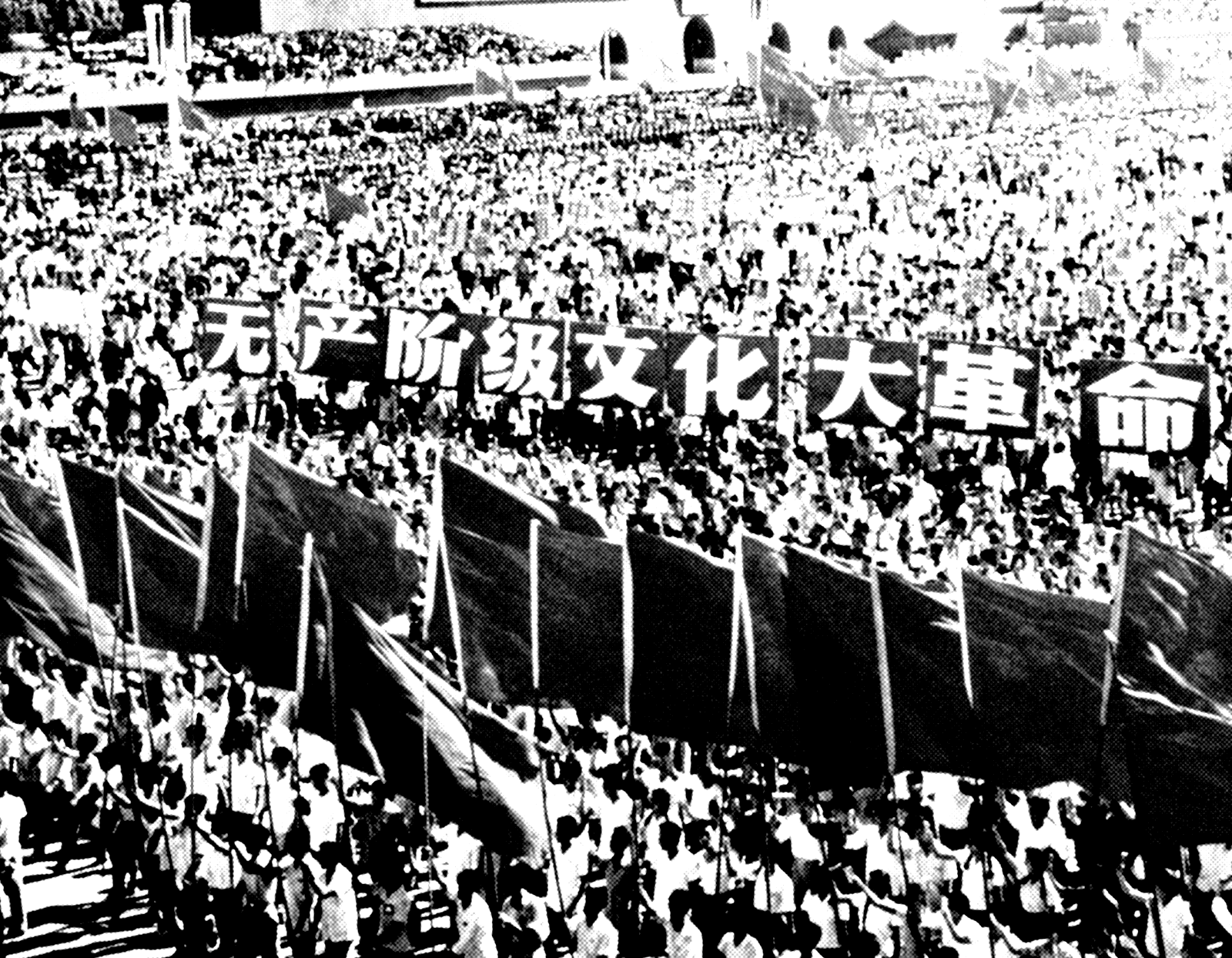
The Chinese Revolution, spanning 1921–1949, opened the space for yet another theoretical and political leap, which was further extended by the Great Proletarian Cultural Revolution (1966–1976), the highest point attained thus far by the world proletarian movement.
On the philosophical plane, this summit is marked by the formal establishment of the law of scission—the primacy of contradiction, the unity of opposites, the division of one into two—as the fundamental law of dialectical materialism. In direct opposition to revisionist theses such as “two combines into one” or the speculative figure of the negation of the negation, the Chinese experience demonstrated that contradiction is the real principle governing the movement of processes, the decisive key for understanding and intervening in the class struggle.
Mao insists on this principle again and again:
“The law of contradiction in things, that is, the law of the unity of opposites, is the fundamental law of nature and of society and therefore also the fundamental law of thought. It stands opposed to the metaphysical world outlook. It represents a great revolution in the history of human knowledge. According to dialectical materialism, contradiction is present in all processes of objectively existing things and of subjective thought and permeates all these processes from beginning to end; this is the universality and absoluteness of contradiction. Each contradiction and each of its aspects have their respective characteristics; this is the particularity and relativity of contradiction. In given conditions, opposites possess identity, and consequently can coexist in a single entity and can transform themselves into each other; this again is the particularity and relativity of contradiction. But the struggle of opposites is ceaseless, it goes on both when the opposites are coexisting and when they are transforming themselves into each other, and becomes especially conspicuous when they are transforming themselves into one another; this again is the universality and absoluteness of contradiction. In studying the particularity and relativity of contradiction, we must give attention to the distinction between the principal contradiction and the non-principal contradictions and to the distinction between the principal aspect and the non-principal aspect of a contradiction; in studying the universality of contradiction and the struggle of opposites in contradiction, we must give attention to the distinction between the different forms of struggle.”20
This insistence on scission as the fundamental principle of dialectics is rooted in real political stakes which took on an increasingly urgent character in the context of the GPCR. Socialist society, according to the Maoists, is not a unified movement advancing smoothly toward communism; it is a terrain on which the antagonistic contradictions of the old society are reproduced and, significantly, intensified, albeit in new forms, until communism or the victory of the counter-revolution. The GPCR’s central insight was that the class struggle continues under socialism: between proletarian and bourgeois lines, between revolutionary and revisionist currents, within the Party, the state, the factory, the school, and even within the lived habits and ideological dispositions of individuals. The law that “one divides into two” asserts that the institutions of the socialist state cannot be conceived of as homogeneous expressions of proletarian power. Rather, they are shot through with the residues of bourgeois society and rearticulations of the class struggle, such that every apparatus contains two lines—one tending toward the consolidation of proletarian dictatorship, the other tending toward the restoration of bourgeois right.
The philosophical debate on this question which raged in the years immediately preceding the initiation of the GPCR is instructive, and we quote at length from a Peking Review article summing it up:
The concept that “one divides into two” is the kernel of the revolutionary philosophy of materialist dialectics, the world outlook of the proletariat. Using this world outlook to apprehend things, the proletariat recognizes that contradictions are inherent in everything, that the two sides of a contradiction are in a state both of unity and of struggle, and that contradiction is the motive force in the development of things. While the identity of opposites is relative, their struggle is absolute. Therefore, the task of materialist dialectics has never been to cover up contradictions, but to disclose them, to discover the correct method for resolving them and to accelerate their transformation, in order to bring about the revolutionary transformation of the world. Using the world outlook of materialist dialectics to analyze class societies, the proletariat recognizes class contradiction and class struggle; it recognizes class struggle as the motive force of social development; it firmly maintains that the proletariat must carry out the class struggle through to the end and so bring about the transformation of society.
But to view relations between the various classes of society in accordance with the concept that “two combine into one” as advocated by Comrade Yang Hsien-chen will inevitably lead to obscuring the boundaries between classes, and to repudiating the class struggle, and thus lead to the theory of class conciliation.
[…]
In the debate, some people made statements which, though differing slightly, coincide in the main with Comrade Yang Hsien-chen’s concept that “two combine into one.” For example, some said that the controversy is merely concerned with phraseology or usage; and added that anyone can make a slip or two when lecturing in the classroom. Others, pretending to be fair and to see the question from all sides, have advanced the idea of using the concept that “two combine into one” to supplement the concept that “one divides into two,” thus making the former into one aspect of the law of unity of opposites; they assert that only in this way can we avoid “one-sidedness.” Others again, pretending to make a concrete analysis of contradictions, divide contradictions into two types: Those which have “unity as their main feature,” and those which have “struggle as their main feature,” claiming that the concept that “two combines into one” should be used in handling contradictions which have “unity as the main feature.” Still others describe the concept that “one divides into two” as a means of analysis and the concept of “two combine into one” as a means of generalization, asserting that each is a component part of the dialectical method of cognition. All these assertions, however, are nothing but attempts to defend the thesis that “two combine into one.”
Many comrades pointed out that the Marxist-Leninist concept that “one divides into two” has its definite meaning and that the concept that “two combine into one” put forward by Yang Hsien-chen, likewise, has its definite meaning. As a technical term, “one divides into two” very accurately, vividly and colloquially expresses the kernel of dialectics, that is, the essence of the law of the unity of opposites, whereas the concept that “two combine into one” put forward by Yang Hsien-chen is systematic metaphysics from beginning to end. These are two fundamentally opposite world outlooks.21
The Chinese Revolution further codified the universality of people’s war as the military line of the proletariat and clarified that the party—understood as its politico-military headquarters—must root its strategy in the mobilization of the masses for the armed struggle to destroy the old state. The decisive terms here are armed struggle and the masses. Mao’s formulation that “political power grows from the barrel of a gun” expresses the materialist conception of state power with unique clarity. Before armed struggle is initiated, all political work must be subordinated to preparing its conditions. But the reverse is also true: military tasks themselves must be subordinated to the political line—hence the dictum that “the party commands the gun.” Politics is placed in command precisely because the masses, and their active participation, constitute the only basis on which revolutionary warfare, the seizure of power, and the subsequent development toward communism become possible. The masses, under the leadership of the proletariat, are the collective producers of the new society: “the only method is for the masses to liberate themselves, and any method of doing things in their stead must not be used.”22
In this context, the mass line becomes the central method for activating and harnessing the initiative of the masses. Grounded in the Marxist theory of knowledge, which posits material social practice as primary in the production of correct ideas, the mass line prescribes a distinct epistemological procedure: the party must go to the masses, gather their dispersed ideas, synthesize these ideas through the lens of scientific theory, and return them in concentrated form, generating a spiral movement in which the party learns to lead while continuously transforming its relation to the masses, and their relation to it. As Mao writes,
“In all the practical work of our Party, all correct leadership is necessarily ‘from the masses, to the masses.’ This means: take the ideas of the masses (scattered and unsystematic ideas) and concentrate them (through study turn them into concentrated and systematic ideas), then go to the masses and propagate and explain these ideas until the masses embrace them as their own, hold fast to them and translate them into action, and test the correctness of these ideas in such action. Then once again concentrate ideas from the masses and once again go to the masses so that the ideas are persevered in and carried through. And so on, over and over again in an endless spiral, with the ideas becoming more correct, more vital and richer each time. Such is the Marxist theory of knowledge.23
This description recalls Lenin’s description of the spiraling dialectic of knowledge, the practice-theory-practice circuit, described in his notes on the Science of Logic:
“Thought proceeding from the concrete to the abstract – provided it is correct (NB) (and Kant, like all philosophers, speaks of correct thought) – does not get away from the truth but comes closer to it. The abstraction of matter, of a law of nature, the abstraction of value, etc., in short all scientific (correct, serious, not absurd) abstractions reflect nature more deeply, truly, and completely. From living perception to abstract thought, and from this to practice – such is the dialectical path of the cognition of truth, of the cognition of objective reality.24
In 1926, Mao raised the question, “who are our enemies, who are our friends?”and thus dismantled the bourgeois-sociological illusion that “the working-class,” “the proletariat,” “the people,” or “the masses” are static empirical blocs, definable by fixed “objective” characteristics. Instead, the determination of friends and enemies must be made in the concrete terrain of class struggle; only systematic social investigation can produce the necessary mapping of class forces in their full complexity. The party must then translate these findings into correct political lines, uniting with its friends and isolating, exposing, and defeating its enemies by mobilizing the masses for struggle.
This process—investigation, analysis, articulation of political line, mass mobilization—repeated throughout the stages of the revolution, culminating in the Great Proletarian Cultural Revolution. The combined experience of the Chinese Revolution and the GPCR revealed the absolute necessity of continuing the revolution under the dictatorship of the proletariat: the socialist social formation remains a class society, structured by antagonisms that cannot be annulled by decree or by the simple fact of legal expropriation of the productive forces. Where Stalin, by 1936, already claimed that the Russian bourgeoisie had been “liquidated,” and that socialism had, in the main, been built, the Chinese experience demonstrated (consistent with the degeneration of the Soviet Union following Stalin’s death) that in each socialist state,
“Although the bourgeoisie has been overthrown, it is still trying to use the old ideas, culture, customs and habits of the exploiting classes to corrupt the masses, capture their minds and endeavour to stage a comeback. The proletariat must do the exact opposite: it must meet head-on every challenge of the bourgeoisie in the ideological field and use the new ideas, culture, customs and habits of the proletariat to change the mental outlook of the whole of society. At present, our objective is to struggle against and overthrow those persons in authority who are taking the capitalist road, to criticize and repudiate the reactionary bourgeois academic “authorities” and the ideology of the bourgeoisie and all other exploiting classes and to transform education, literature and art and all other parts of the superstructure not in correspondence with the socialist economic base, so as to facilitate the consolidation and development of the socialist system.”25
Without ongoing struggle against the cultural remnants, political practices, and ideological-juridical survivals of the old order—most visibly embodied in the defense of bourgeois right—the bourgeoisie will reconstitute itself within the socialist social formation, primarily within the party, and attempt to initiate capitalist restoration under the ideological banner of modern revisionism: developmentalism, productive-forces determinism, social chauvinism, the marginalization of the transformation of the relations of production, peaceful coexistence, etc.
Only through the construction of a proletarian cultural and ideological practice, sustained by relentless struggle against bourgeois tendencies inside the party, state and society as a whole can the socialist road be defended and extended. It is this, and only this, which can push the revolutionary movement to new heights beyond those yet achieved.
A Brief Note on the Establishment of Marxism-Leninism-Maoism
Following the defeat of the GPCR and the subsequent capitalist restoration in China, the international communist movement entered a profound ideological crisis, marked by the disappearance of the socialist state that had served as its principal theoretical and political center. In this vacuum, several organizations that had upheld “Marxism-Leninism-Mao Zedong Thought” since the GPCR sought to reconstitute an international locus of ideological and strategic coordination, culminating in the formation of the Revolutionary Internationalist Movement (RIM) in 1983. Within this tendency, the Communist Party of Peru–Shining Path (PCP–SL) played a leading role. During the high tide of its People’s War (1980–1992), the PCP emerged as the vanguard ideological force within the RIM, pressing the argument that Maoism must be recognized not merely as a national crystallization of Marxism-Leninism but as a qualitatively new and higher stage of Marxism itself. Although, since the Great Debate, various parties had oscillated between “Mao Zedong Thought” and “Maoism,” and although some had gestured ambiguously toward Maoism as a distinct stage, it was the PCP–RIM sequence that first systematized Maoism as an internally coherent theoretical synthesis. The formal adoption of Maoism as the advanced stage of Marxism by the RIM in 1993 marked a significant, if uneven and contested, development in the history of revolutionary theory.
Yet the degeneration of the RIM under the weight of opportunism and revisionism—most notably the trajectories of Avakian’s RCP and Prachanda’s CPN (Maoist), respectively deranged and capitulationist—resulted in the dissolution of this attempted ideological center by the late 2000s. The contemporary international Maoist movement thus finds itself once again dispersed, lacking a unified theoretical anchor. While the ongoing People’s Wars in the Philippines and India remain crucial sources of strategic and ideological experience—and the defeats in Peru and Nepal, as well as the rise and collapse of the RIM sequence, offer indispensable lessons—the absence of an international center imposes a renewed responsibility: to continue the labor of theoretical development ourselves. The present document is offered in that spirit: an effort to articulate Maoism in its current determinate form, to intervene in ongoing internal debates, and to participate in the collective process through which our ideology develops in and through struggle.
1CPI (Maoist), “Hold High the Bright Red Banner of Marxism-Leninism-Maoism!” 2004.
2Marx and Engels, Manifesto of the Communist Party. 1848.
3Marx to J. Weydemeyer in New York, March 5, 1852
4Marx, Introduction to A Contribution to the Critique of Political Economy, 1859
5Marx and Engels, Manifesto of the Communist Party, 1848
6op cit.
7Marx, Capital vol. 1
8Lenin, “Plan of Hegel’s Dialectics.” 1915.
9Marx, Theses on Feuerbach. 1845
10Engels, Anti-Dühring. Herr Eugen Dühring’s Revolution in Science. 1877.
11Marx, Critique of the Gotha Programme. 1875.
12Lenin, The Proletarian Revolution and The Renegade Kautsky. 1918.
13op. cit.
14Lenin, “How Vera Zasulich Demolishes Liquidationism.” 1913.
15Lenin, Materialism and Empirio-Criticism. 1908.
16Lenin, “On The Question of Dialectics.” 1915.
17op cit.
18Stalin, “Foundations of Leninism.” 1924
19Ajith, “On The Maoist Party.” 2009.
20Mao, On Contradiction. 1937.
21‘New Polemic on the Philosophical Front: Report on the Discussion Concerning Comrade Yang Hsien-chen’s
Concept That ‘Two Combine Into One.’’ Peking Review, Vol. 7, #37, Sept. 11, 1964.
22“Decision of the Central Committee of the Chinese Communist party Concerning the Great Proletarian Cultural Revolution,” adopted on August 8, 1966.
23Mao, “Some questions concerning methods of leadership.” 1943.
24Lenin, Conspectus to Hegel’s Science of Logic, 1914.
25‘Directive…’ op cit.